
Composites have moved from niche materials to core components of modern manufacturing. Aerospace, automotive, renewables and medical are just four of the sectors that rely on composites to deliver lighter, stronger products.
In this article, we’ll take an in-depth look at composites. We’ll also share how Creo by PTC helps manufacturers make the most of these versatile materials.
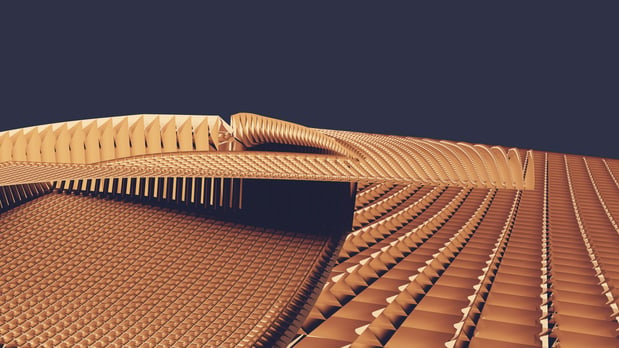
Composite Benefits
The main benefit of composites is the strength-to-weight advantage. For example, in automotive manufacturing, a 10% reduction in vehicle weight can improve fuel efficiency by up to 8%. It’s no surprise that designers outside the traditional sectors are waking up to the value of composites, and we’re seeing them now in recreation and consumer products.
Composites also support sustainability goals by enabling engineers to place strength only where it is required, reducing excess material and improving durability.
Design Challenges
However, these benefits come with complexity. Composite parts require precise definition at every level. Engineers must control ply orientation, stacking order, transition zones and layup details. Each decision affects structural performance and manufacturability.
Unlike isotropic metals, composites are anisotropic. Their mechanical properties vary with direction. This makes analysis more demanding and increases the importance of accurate modelling. A small design change can alter performance significantly.
Traditional workflows struggle in this environment. When CAD, CAE and PLM systems operate separately, data becomes fragmented. Designers lose visibility into manufacturing constraints. Manufacturing teams lose insight into design intent. These disconnects slow development and increase risk. Managing this complexity demands an integrated digital design environment.
Creo makes composites work
Creo delivers that connected environment. It supports composite design from concept through to manufacturing documentation within one integrated system.
With Creo 10, PTC delivered a comprehensive composites toolkit. Engineers gained the ability to create ply-based layups and generate automated manufacturing documentation directly from the model. This reduced manual effort and improved consistency.
Creo 11 expanded these capabilities further. Zone-based design allowed more precise control over composite regions. Enhanced transition management improved how plies blend across geometry. Support for laser projection enabled more accurate guidance during hand layup and automated placement.
Now, we’re at version 12 with new performance and usability enhancements:
-
- Faster 3D laminate modelling for complex composite structures
- Associative manufacturing reference models that link design directly to production intent
- Merged-zone capabilities to simplify management
- Improved draping controls for better simulation
And there are more enhancements still to come. Future versions of Creo will introduce support for composite inserts, deeper simulation integration and AI-driven automation.
Looking to the future
Composites are shaping the future of manufacturing. Their strength-to-weight advantages and sustainability benefits are clear, even if the details are complex.
To manage that complexity, engineers need tools that connect design, analysis and manufacturing. Creo provides that integrated environment, enabling teams to design advanced composite structures with precision and confidence.
To find out more, click here.